Discover tailored solutions for your business needs with our free quote service. Let our experts at HSR Hi-Tech Solutions guide you towards success. Request your complimentary quote today!
Thank you!
Your request has been submitted successfully.
Our team will reach out to you soon.
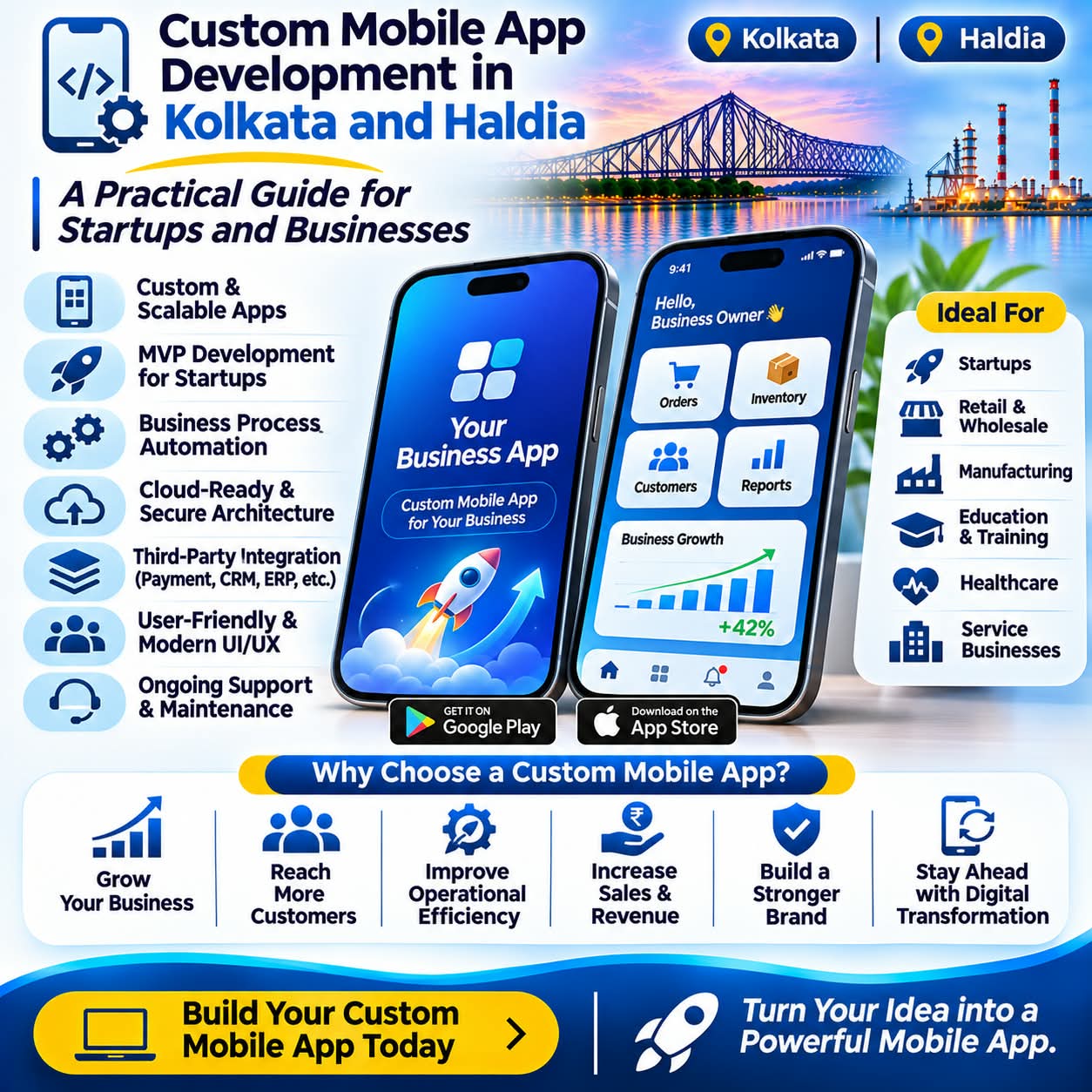
Custom Mobile App Development in Kolkata and Haldia: A Practical Guide for Startups and Businesses
Looking for custom mobile app development in Kolkata or Haldia? Explore Android, iOS and cross-platform app solutions for startups and businesses.
S
System Admin
· 10 min read
In this article
Custom Mobile App Development in Kolkata and Haldia: A Practical Guide for Startups and Businesses
Smartphones have become an important part of how customers discover businesses, purchase products, access services and communicate with organisations. For businesses, mobile applications create opportunities to provide convenient digital experiences and build stronger customer relationships.
Startups and established organisations in Kolkata and Haldia are increasingly exploring mobile applications to improve customer engagement, automate business processes and offer services through digital platforms.
However, developing a successful mobile application involves more than creating attractive screens. Businesses need to consider their target audience, application features, technology, security, performance and long-term maintenance.
In this guide, we explain how custom mobile app development works, which features businesses should consider and how to choose the right development partner.
What Is Custom Mobile App Development?
Custom mobile app development is the process of designing and building an application around the specific requirements of a business or organisation.
Unlike generic applications that offer the same functionality to every customer, custom applications can be developed around a company's services, workflows, customers and business objectives.
A custom mobile application may include:
User registration and login
Customer dashboards
Product and service catalogues
Online booking and appointment systems
Payment gateway integration
Push notifications
Location-based services
Order and delivery tracking
Admin dashboards
Reports and analytics
Third-party API integrations
The required functionality depends on the application type and the problems it is intended to solve.
Why Businesses in Kolkata and Haldia Are Considering Mobile Apps
A mobile application can provide value when customers or employees need regular access to a business's services.
Here are some practical reasons organisations consider developing their own applications.
1. Improve Customer Accessibility
A mobile app can provide customers with a dedicated way to access services, view information, make enquiries and manage their accounts.
Instead of repeatedly visiting a website or contacting staff for routine activities, users may be able to complete supported tasks directly through the application.
2. Build Direct Customer Relationships
Businesses can use mobile applications to communicate with registered users through notifications, account updates and relevant announcements.
Communication should be permission-based and useful rather than excessive.
3. Simplify Business Operations
Internal business applications can help employees manage tasks, attendance, approvals, field activities and operational information.
For example, a company with field employees may require a mobile application for task updates and location-based attendance.
4. Support Online Sales and Services
Retailers, restaurants, service providers and other businesses can use mobile apps to offer product catalogues, bookings, orders and payment functionality.
The application can also be connected to an administrative dashboard for managing relevant business activities.
5. Create New Digital Business Models
Startups can use mobile applications to introduce services such as marketplaces, subscription platforms, education applications, booking systems and community networks.
A custom application can be developed around the business model instead of adapting the business to a generic platform.
Types of Mobile Applications Businesses Can Develop
The right application type depends on the intended users and the business problem.
1. Customer-Facing Mobile Applications
These applications allow customers to interact directly with a business.
Examples include:
Shopping applications
Restaurant ordering applications
Appointment booking applications
Hotel reservation applications
Service marketplace applications
Customer loyalty applications
2. Business and Employee Applications
Internal applications help organisations manage employee activities and operational workflows.
Examples include:
Employee attendance applications
Field workforce management
Task and project tracking
Sales team applications
Inventory management
Internal communication platforms
3. Education and Learning Applications
Educational institutions and training organisations can use mobile applications to distribute learning materials and manage student activities.
Possible features include video lessons, online tests, course progress, notifications and student dashboards.
4. Healthcare and Appointment Applications
Healthcare-related applications may support appointment booking, patient-facing information, consultation scheduling and administrative workflows.
Applications handling sensitive information should be designed with appropriate privacy, access control and security requirements.
5. On-Demand Service Applications
Businesses offering services at customers' locations may need applications for booking, service-provider allocation, order tracking and payment management.
These applications can include separate interfaces for customers, service providers and administrators.
Android vs iOS vs Cross-Platform App Development
One of the first technical decisions is choosing which platforms the application should support.
Factor
Android App
iOS App
Cross-Platform App
Target devices
Android smartphones and tablets
Apple devices
Android and iOS
Development approach
Native Android development
Native iOS development
Shared application codebase
User experience
Designed for Android
Designed for Apple platforms
Can provide a consistent experience across platforms
Development effort
Separate Android project
Separate iOS project
Often reduces duplicated development
Best suited for
Android-focused audiences
iPhone and iPad users
Businesses targeting both platforms
Native App Development
Native development uses platform-specific technologies to build applications for Android or iOS.
It can be appropriate when an application requires specialised platform capabilities or highly customised native experiences.
Cross-Platform App Development
Cross-platform frameworks allow developers to build applications for multiple operating systems using a shared codebase.
Technologies such as Flutter and React Native can be considered for projects targeting both Android and iOS.
The choice should depend on application complexity, performance requirements, integrations, team capabilities and long-term maintenance.
Essential Features of a Successful Business Mobile App
A mobile application should make important tasks simple for its users. Adding unnecessary features can increase development complexity without improving the overall experience.
Consider these core components.
1. Simple User Registration and Login
The registration process should collect only the information required for the application.
Depending on the project, authentication may support email, mobile number, password, OTP or supported social sign-in options.
2. User-Friendly Interface
Users should be able to understand the application without extensive instructions.
Clear navigation, readable content, accessible controls and consistent design help improve usability.
3. Secure Backend and Database
Most business applications need a backend to manage user accounts, transactions, content and application data.
The backend architecture should be planned according to expected usage, security requirements and future expansion.
4. Payment Gateway Integration
Applications that sell products, services or subscriptions may require payment gateway integration.
The payment workflow should support appropriate transaction confirmation, payment status tracking and reconciliation.
5. Push Notifications
Push notifications can communicate important updates such as booking confirmations, order status, reminders and announcements.
Users should have appropriate notification preferences, and businesses should avoid unnecessary messages.
6. Admin Dashboard
A web-based administration panel can help authorised staff manage users, products, bookings, content and reports.
For many businesses, an admin dashboard is as important as the mobile application itself.
7. Analytics and Reporting
Application analytics can help businesses understand user engagement, feature usage, conversion events and technical performance.
Reports should focus on measurable business objectives rather than collecting unnecessary personal information.
Mobile App Development Process: From Idea to Launch
A structured development process helps businesses manage project scope, cost and delivery expectations.
Step 1: Requirement Analysis
The first step is to understand the business idea and identify the application users.
The development team should establish:
Target audience
Business objectives
Core application features
Required platforms
User roles
Third-party integrations
Budget and expected timeline
Step 2: UI/UX Design
The design stage defines how the application will look and how users will interact with it.
Wireframes and prototypes can help stakeholders review navigation and workflows before development begins.
Step 3: Technology Selection
The technology stack should be selected based on project requirements.
A typical mobile application architecture may include:
Flutter or React Native for cross-platform development
Native Android or iOS technologies where required
Node.js or another suitable backend technology
Firebase or a suitable database solution
Cloud infrastructure for hosting and storage
Payment and notification integrations
The final stack should reflect security, scalability, budget and maintenance requirements.
Step 4: Application Development
Developers implement the approved designs and application functionality.
This may include frontend screens, backend APIs, database structures, authentication, payment integration and the admin dashboard.
Step 5: Testing and Quality Assurance
Before launch, the application should be tested across supported devices and operating system versions.
Testing should cover:
Login and registration
Navigation and user experience
API communication
Payment workflows
Data validation
Security controls
Performance
Error handling
Step 6: Deployment and Launch
The application can be prepared for release through the relevant app distribution platforms.
Publishing requires compliance with applicable store policies, application disclosures, permissions and review processes.
Step 7: Maintenance and Improvements
After launch, applications need ongoing technical attention.
Updates may include bug fixes, operating system compatibility changes, performance improvements, security updates and new features based on user feedback.
How Much Does Mobile App Development Cost in Kolkata?
The cost of mobile application development depends on the project's scope and technical complexity. There is no single price that applies to every business application.
Some important cost factors include:
Number of platforms: Android-only development may have a different cost from applications supporting both Android and iOS.
Application complexity: A basic information application is different from a marketplace or multi-user business platform.
Backend development: Authentication, database design, APIs and server-side business logic influence the project scope.
Admin dashboard: A separate administrative system adds design, development and testing requirements.
Third-party integrations: Payment gateways, maps, messaging, analytics and external APIs may require additional implementation.
UI/UX design: Custom interfaces and complex workflows require additional design and testing.
Maintenance: Hosting, updates, monitoring and technical support should be considered as recurring expenses.
Businesses should request an itemised proposal that clearly explains the development scope, milestones, deliverables and ongoing costs.
How to Choose a Mobile App Development Company in Kolkata or Haldia
Selecting the right technology partner can influence the application's quality and long-term success.
Before finalising a development company, consider the following:
Review its portfolio: Look for relevant applications and software projects rather than relying only on promotional claims.
Understand the technology stack: Ask why the proposed framework and backend technologies are appropriate for your requirements.
Check the development process: Confirm that requirement analysis, design, testing and deployment are included.
Clarify source code ownership: Ensure the contract explains ownership of source code, project assets and relevant accounts.
Discuss data security: Understand how user data, authentication and application permissions will be handled.
Review post-launch support: Ask about maintenance, bug fixes, updates and support arrangements.
Request a written quotation: The proposal should explain features, exclusions, timelines and payment milestones.
Custom Mobile App Development by HSR Hi-Tech Solutions
HSR Hi-Tech Solutions is an MSME-registered and ISO-certified IT company with offices in Kolkata and Haldia, West Bengal.
The company develops digital solutions including websites, mobile applications, ERP systems, custom software and cloud-based platforms.
Its in-house products include applications such as HSR Billbook, HSR SmartAttend, PrepKendra and Luvlyy, reflecting experience in building and operating software products.
HSR can help businesses plan mobile application projects based on their requirements, including:
Android and iOS application development
Cross-platform mobile applications
Custom backend and API development
Admin dashboard development
Payment gateway integration
Cloud and database integration
Application maintenance and technical support
Whether you are a startup planning a new digital product or an established business looking to improve customer services, the development process should begin with a clear understanding of your objectives.
Visit HSR Hi-Tech Solutions to explore its services and portfolio:
Custom mobile app development is the process of creating an application around a business's specific requirements, workflows, target audience and services.
2. Can a company in Kolkata develop both Android and iOS applications?
Yes. A development company can build separate native applications or use a cross-platform framework to support Android and iOS, depending on project requirements.
3. Is Flutter suitable for business mobile applications?
Flutter can be suitable for many business applications because it supports cross-platform development with a shared codebase. The final technology choice should depend on the application's features and technical requirements.
4. How long does it take to develop a mobile application?
The timeline depends on the number of features, platforms, integrations, design complexity and testing requirements. A basic application may take considerably less time than a large multi-user platform.
5. Do mobile applications require an admin dashboard?
Not every application requires a separate admin dashboard, but many business applications benefit from one. It can help authorised staff manage users, content, orders, bookings and reports.
6. Can an existing business website be converted into a mobile app?
A website can sometimes be adapted into an app-like experience, but a full mobile application may require additional development for native device features, offline functionality, notifications and platform-specific requirements.
7. Does HSR Hi-Tech Solutions provide mobile app maintenance?
HSR provides technical support and maintenance services. The specific mobile application maintenance scope should be discussed and agreed as part of the project proposal.
Conclusion
Mobile applications can help businesses improve customer experiences, simplify operations and introduce new digital services. However, a successful application requires thoughtful planning, suitable technology, reliable development and ongoing maintenance.
For startups and established organisations in Kolkata and Haldia, custom mobile app development offers an opportunity to build digital products around real business requirements.
HSR Hi-Tech Solutions helps organisations plan and develop mobile applications, backend systems and connected digital platforms.
Have a mobile app idea for your business or startup?
Part of the team at HSR Hi-Tech Solutions, an MSME-registered IT company in Kolkata and Haldia building websites, apps, ERP and AI solutions, and running the marketing campaigns we write about.

.jpeg)