Discover tailored solutions for your business needs with our free quote service. Let our experts at HSR Hi-Tech Solutions guide you towards success. Request your complimentary quote today!
Thank you!
Your request has been submitted successfully.
Our team will reach out to you soon.
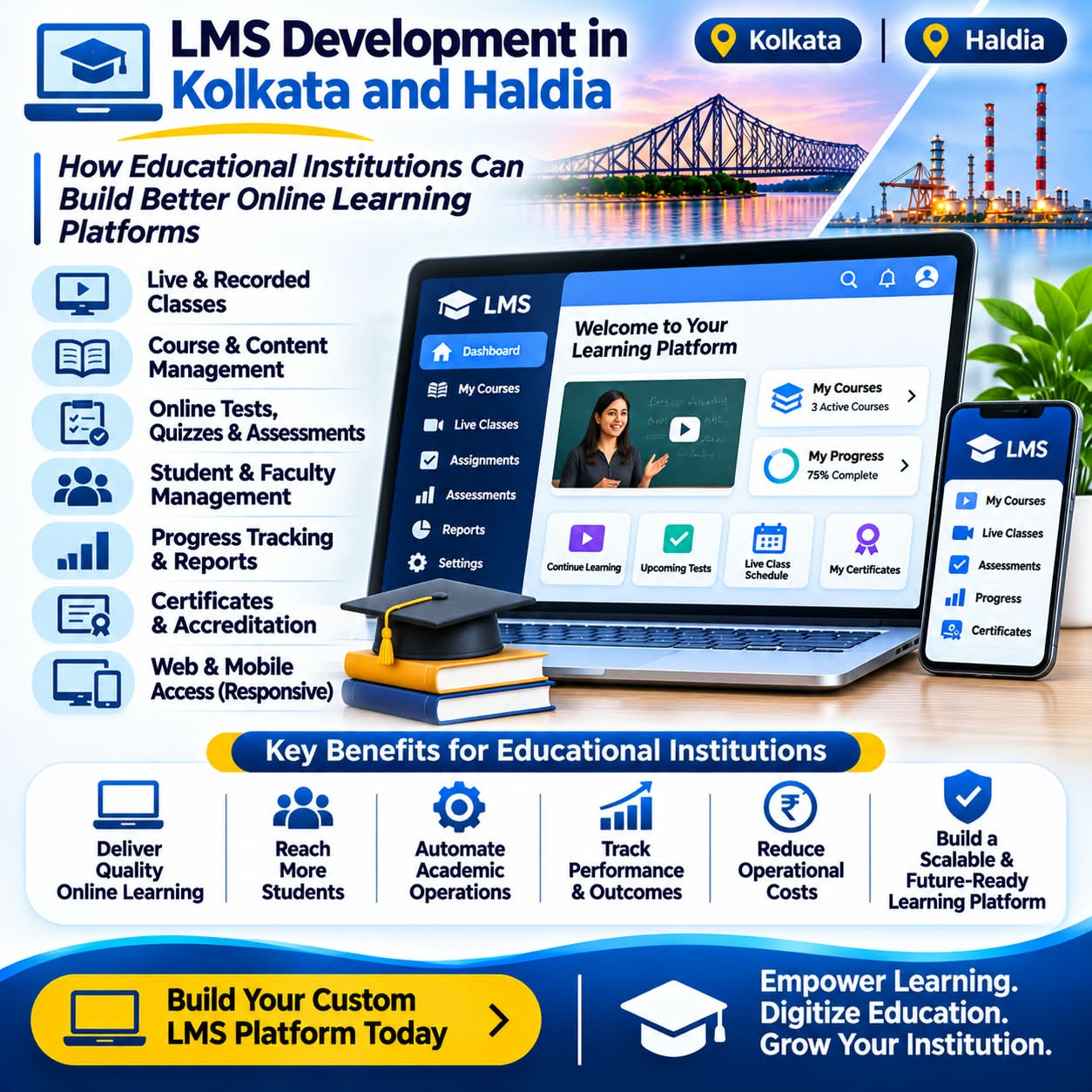
LMS Development in Kolkata and Haldia: How Educational Institutions Can Build Better Online Learning Platforms
Looking for LMS development in Kolkata or Haldia? Explore custom e-learning platforms for colleges, coaching centres and training institutes.
S
System Admin
· 8 min read
In this article
LMS Development in Kolkata and Haldia: How Educational Institutions Can Build Better Online Learning Platforms
Digital education has changed how students access learning materials, attend classes and interact with instructors. Colleges, coaching centres, professional training institutes and corporate training teams increasingly need platforms that support learning beyond the traditional classroom.
For educational organisations in Kolkata and Haldia, a Learning Management System (LMS) can provide a centralised platform to organise courses, upload study materials, conduct assessments and monitor student progress.
Instead of managing everything through separate messaging groups, spreadsheets and file-sharing platforms, institutions can bring important learning activities together through a dedicated online platform.
In this article, we explore LMS development, essential features, benefits and how educational institutions can choose the right e-learning software.
What Is a Learning Management System (LMS)?
A Learning Management System is a software platform used to create, organise, deliver and manage educational or training programmes.
An LMS allows administrators and instructors to manage courses while students access learning resources through a web or mobile interface.
Depending on the platform's capabilities, an LMS may include:
Online course creation and management
Video lectures and recorded sessions
PDF notes and downloadable resources
Student registration and enrolment
Online examinations and quizzes
Assignment submission
Progress tracking
Certificates and completion records
Notifications and announcements
An LMS can be developed for schools, colleges, coaching institutes, skill-development centres, online educators and corporate training departments.
Why Educational Institutions in Kolkata and Haldia Need LMS Software
Educational institutions often manage large amounts of learning material and student information. When these activities are handled through disconnected tools, it can become difficult to maintain consistency.
A dedicated LMS can address several common challenges.
1. Managing Study Materials in One Place
Students often receive notes, presentations, assignments and recorded lectures through different channels.
An LMS can organise these resources course-wise, subject-wise or batch-wise, making it easier for learners to find the materials they need.
2. Supporting Online and Hybrid Learning
Institutions may conduct classroom sessions alongside online classes. An LMS can provide a common platform for sharing resources, assignments and recorded lessons.
This helps students access relevant learning materials even when they are not physically present on campus.
3. Monitoring Student Progress
Instructors and administrators may need to understand whether students are completing lessons, attending assessments and submitting assignments.
An LMS with progress-tracking functionality can help institutions review learner activity and identify areas where additional support may be required.
4. Simplifying Online Assessments
Conducting tests manually can require significant administrative effort.
An LMS can support online quizzes, objective assessments and assignment submissions. More advanced platforms may also include question banks, timed examinations and evaluation workflows.
5. Improving Communication
Course announcements, schedule changes and important academic updates can be distributed through a centralised platform.
This reduces dependence on multiple communication channels for routine academic information.
Essential Features of a Custom LMS Platform
The right LMS should be designed around the institution's teaching model, student requirements and administrative workflows.
Here are important features to consider.
1. Student Registration and Login
Students should be able to register or receive accounts through an administrator-managed enrolment process.
Secure authentication and appropriate access permissions help protect course information and learner accounts.
2. Course and Batch Management
Administrators should be able to create courses, subjects, batches and learning groups.
This is particularly useful for coaching institutes and training centres that run multiple programmes simultaneously.
3. Video Lecture Management
An LMS can provide access to recorded lectures and online learning videos.
Depending on the platform design, video content may be hosted through a suitable streaming provider or integrated with an external video platform.
4. Notes and Study Material Uploads
Teachers should be able to upload learning resources such as:
PDF notes
Presentations
Documents
Reference materials
Recorded lectures
Practice exercises
Organised content access helps students follow a structured learning path.
5. Online Examination and Quiz Module
An assessment module can support:
Multiple-choice questions
Subject-wise question banks
Timed tests
Automatic evaluation for supported question types
Assignment submissions
Result generation
Institutions should select examination features based on their assessment requirements.
6. Student Progress Dashboard
A student dashboard can display enrolled courses, completed lessons, upcoming assessments and available results.
Teachers and administrators may receive separate dashboards with appropriate access to learner progress and course activity.
7. Assignment and Evaluation Management
Students can submit assignments online, while instructors review submissions and provide marks or feedback.
This creates a more structured process for coursework and academic evaluation.
8. Certificates and Course Completion
Training institutes may want to issue certificates after learners complete specified course requirements.
A custom LMS can include certificate generation based on defined completion and assessment criteria.
9. Mobile-Friendly Learning Experience
Many students access educational resources through smartphones.
An LMS should provide a responsive interface across desktops, tablets and mobile devices. Institutions with more advanced requirements may also consider dedicated Android and iOS applications.
LMS for Different Types of Educational Organisations
A learning management system is not limited to traditional colleges. Different organisations can use customised LMS platforms for their specific training needs.
LMS for Colleges and Universities
Colleges can use LMS platforms to distribute study materials, organise subjects, manage assignments and provide access to recorded lectures.
LMS for Coaching Centres
Competitive examination coaching centres may use LMS software to manage batches, share notes, conduct mock tests and track student performance.
LMS for Professional Training Institutes
Institutes offering programming, digital marketing, accounting, design and technical courses can organise their training programmes through a dedicated learning platform.
LMS for Corporate Training
Companies can use LMS platforms to distribute employee training materials, manage learning programmes and track course completion.
LMS for Online Educators
Independent educators and training businesses can use a custom LMS to offer structured courses and manage enrolled learners.
Custom LMS Development vs Ready-Made LMS
Institutions generally have two options: adopt an existing LMS platform or develop a custom solution.
Comparison
Ready-Made LMS
Custom LMS Development
Initial setup
Often quicker
Requires planning and development
Features
Based on available plans and extensions
Can be designed around specific requirements
User interface
May offer limited customisation
Greater control over the experience
Integrations
Depends on available integrations
Can be developed for required workflows
Scalability
Depends on platform architecture and plan
Can be planned around expected growth
Maintenance
Depends on provider or internal team
Requires an agreed maintenance arrangement
A ready-made LMS may be suitable for institutions with standard requirements. Custom LMS development may be worth considering when an organisation needs specialised examinations, unique enrolment processes, custom reporting or integrations with existing systems.
The best choice depends on the institution's budget, technical requirements and long-term plans.
Important Considerations Before Developing an LMS
Developing an LMS requires more than building a course listing page. Institutions should plan the learning experience and administrative workflow before development begins.
Consider the following points:
Define the user roles: Identify the permissions required for administrators, teachers, students and other users.
Plan the course structure: Decide how subjects, batches, lessons and learning materials will be organised.
Estimate video storage and bandwidth: Video-heavy platforms require appropriate hosting and streaming arrangements.
Consider examination requirements: Define question types, time limits, evaluation rules and result visibility.
Protect student information: Use appropriate authentication, access controls, secure data handling and backup arrangements.
Plan for future growth: Consider expected student numbers, concurrent users, additional courses and mobile access.
Set a maintenance plan: Software updates, security reviews, backups and technical support should be included in the long-term plan.
LMS Development Services in Kolkata and Haldia
Educational institutions looking for LMS development in Kolkata or Haldia should work with a technology partner that understands both software development and the institution's operational requirements.
HSR Hi-Tech Solutions provides IT services including web development, mobile application development, custom software development, cloud computing and AI-based solutions.
The company can help organisations plan and develop digital platforms around their requirements, including course management workflows, student portals, online assessments and learning interfaces.
Rather than selecting features without a clear objective, institutions should begin with their teaching model and identify the features that will make the biggest difference to students and administrators.
Frequently Asked Questions
1. What is LMS development?
LMS development is the process of designing and building software that helps organisations create courses, distribute learning materials, manage students, conduct assessments and monitor learning progress.
2. How much does custom LMS development cost in Kolkata?
The cost depends on the number of modules, user roles, video infrastructure, assessment requirements, integrations, mobile application needs and expected user capacity. A detailed requirement analysis is necessary before providing an estimate.
3. Can an LMS be developed for a coaching centre in Haldia?
Yes. A custom LMS can be designed for coaching centres to manage student batches, upload study materials, conduct mock tests, share recorded lectures and monitor student progress.
4. Can students access an LMS through mobile phones?
Yes. An LMS can be designed with a responsive interface for mobile browsers. Dedicated Android and iOS applications can also be developed if required.
5. Can an LMS conduct online examinations?
An LMS can include examination modules with features such as question banks, timed quizzes, objective questions and result generation. Advanced examination requirements should be defined during the planning stage.
6. How long does it take to develop an LMS?
Development time depends on the project scope, design complexity, integrations, assessment modules and testing requirements. A basic learning portal and a comprehensive multi-institution LMS will have different development timelines.
7. Which businesses and institutions can benefit from LMS software?
Schools, colleges, universities, coaching centres, skill-development institutes, online educators and corporate training departments can benefit from an LMS.
Conclusion
A Learning Management System can help educational institutions organise digital learning, simplify course administration and provide students with structured access to educational resources.
For colleges, coaching centres and training institutes in Kolkata and Haldia, an LMS can support classroom learning, online education and hybrid training programmes through a centralised digital platform.
The right solution should reflect the institution's actual teaching requirements, student capacity and future growth plans.
HSR Hi-Tech Solutions helps organisations explore custom software, web platforms and mobile applications designed around their operational needs.
Planning an LMS or online learning platform for your institution?
Part of the team at HSR Hi-Tech Solutions, an MSME-registered IT company in Kolkata and Haldia building websites, apps, ERP and AI solutions, and running the marketing campaigns we write about.
Connect business applications with API integration services in Kolkata and Haldia. Improve data exchange, automate workflows and streamline operations.