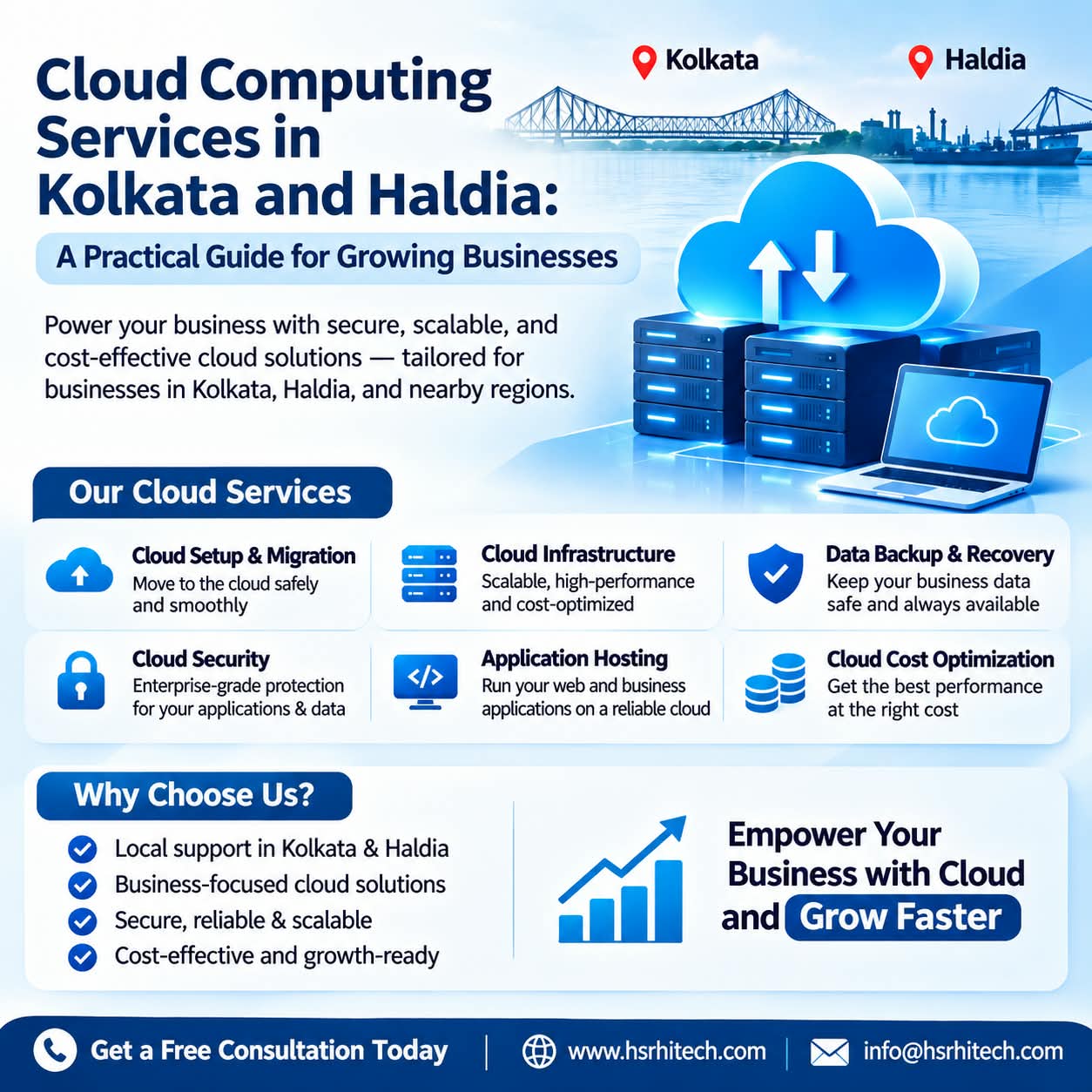
Cloud Computing Services in Kolkata and Haldia: A Practical Guide for Growing Businesses
Businesses today rely on digital tools to manage customer information, employee records, financial documents, websites and daily operations. As these systems grow, traditional IT infrastructure can become difficult and expensive to maintain. This is why cloud computing is becoming an important option for businesses looking to improve flexibility, accessibility and operational efficiency.
For companies in Kolkata, Haldia and across West Bengal, cloud technology can support everything from website hosting and secure file storage to business applications, database management and disaster recovery.
HSR Hi-Tech Solutions helps businesses explore technology solutions that align with their operational needs and long-term digital goals.
What Is Cloud Computing?
Cloud computing allows businesses to access computing resources such as servers, storage, databases, networking and software over the internet instead of relying entirely on physical infrastructure at their premises.
Rather than purchasing and maintaining every server themselves, businesses can use suitable cloud services and scale resources according to demand.
For example, a growing company in Kolkata may host its website and customer management application on cloud infrastructure. Its employees can access authorised systems remotely, while the business can adjust resources as its workload changes.
Cloud services can be used for websites, mobile applications, business software, data storage, analytics and other digital operations. Their suitability depends on the application's requirements, budget and security needs.
Why Businesses in Kolkata and Haldia Should Consider Cloud Computing
1. Reduce the Need for Expensive On-Site Infrastructure
Maintaining physical servers involves hardware purchases, maintenance, electricity, physical space and technical support. Cloud computing can reduce the need for some of these upfront investments.
Many cloud services use consumption-based pricing, allowing businesses to pay according to the resources they use. However, costs must be monitored because storage, data transfer, backups and computing usage can increase expenses.
2. Access Business Systems from Different Locations
Companies with multiple offices, remote employees, field teams or travelling managers may need secure access to business information from different locations.
Cloud-hosted applications can support authorised access to shared documents, customer records, reports and internal systems, subject to appropriate permissions and internet availability.
This can be useful for organisations operating between Kolkata, Haldia and other business centres.
3. Scale as Your Business Grows
A business may begin with a simple website and a small database, then expand to include customer portals, mobile applications, reporting tools and automated workflows.
Cloud infrastructure can make it easier to increase or decrease computing resources as demand changes. This flexibility can help businesses avoid committing too early to infrastructure that may not match their future needs.
4. Improve Data Backup and Recovery Planning
Losing important business data can interrupt operations and create financial and administrative difficulties.
A properly designed cloud backup strategy can help protect important files, databases and application data. Businesses should define backup frequency, retention periods, access permissions and recovery procedures.
Cloud storage alone does not guarantee recoverability. Independent backups, appropriate access controls and regular restoration tests remain important.
5. Support Business Continuity
Hardware failure, accidental deletion or other disruptions can affect business operations. A cloud environment designed with suitable redundancy, backups and recovery arrangements can help reduce the impact of certain incidents.
The right level of resilience depends on the business's recovery objectives, application architecture and budget.
6. Support Collaboration and Digital Transformation
Cloud technology can connect business applications, databases, analytics and automation tools.
For example, a company can integrate its customer relationship management system with reporting software, or connect a mobile application to a cloud-hosted backend. These integrations can reduce repetitive work and make business information easier to manage.
Cloud Computing Services Businesses May Need
Choosing the right service is more important than moving everything to the cloud without a plan.
Cloud Hosting and Application Deployment
Cloud hosting provides the infrastructure required to run websites, web applications, APIs and business portals. It can be suitable for organisations that need reliable access to digital services and the flexibility to adjust capacity.
Cloud Migration
Cloud migration involves moving selected applications, databases, files or workloads from existing infrastructure to an appropriate cloud environment.
A structured migration generally includes reviewing the current system, identifying dependencies, planning data transfer, testing functionality and preparing a rollback or recovery plan.
Businesses do not always need to move everything at once. A phased approach may reduce disruption.
Cloud Storage and Data Backup
Cloud storage can help organisations centralise files and maintain copies of important information. Backup solutions should be configured according to the sensitivity and importance of the data.
Businesses should also consider encryption, access permissions, retention policies and recovery testing.
Cloud Database Management
Websites, ERP platforms, CRM systems and mobile applications often depend on databases. Cloud database services can provide managed infrastructure, backup options and capacity adjustments, depending on the selected provider and service configuration.
Database design, security rules, monitoring and cost management are still essential.
Cloud Infrastructure Management
Businesses may require assistance with server configuration, deployment, monitoring, security settings, updates and performance optimisation.
Managed cloud support can help organisations maintain their systems without building every technical capability internally.
Which Industries Can Benefit from Cloud Computing in Kolkata and Haldia?
Manufacturing and Industrial Businesses
Manufacturing companies can use cloud-hosted applications for inventory records, production reports, maintenance tracking and coordination between departments.
Industrial organisations should evaluate network reliability, operational requirements and security before connecting critical systems.
Educational Institutions
Schools, colleges and training organisations may use cloud infrastructure to host websites, student portals, learning platforms, online assessments and administrative applications.
A suitable design can help authorised users access services without requiring every application to run on a local server.
Retailers and Distributors
Retail businesses can use cloud-based inventory systems, customer databases, online stores and reporting tools to coordinate operations across locations.
Professional Service Providers
Consultancies, agencies and service businesses may benefit from cloud-hosted CRM systems, project management tools, document storage and business dashboards.
Startups and Small Businesses
Startups can begin with infrastructure that fits their current requirements and expand as their customer base and workload grow. Careful cost monitoring is important to avoid paying for unused resources.
How to Choose the Right Cloud Computing Solution
Before selecting a provider or planning a migration, businesses should consider the following factors:
Business requirements: Identify which applications, files and processes need cloud infrastructure.
Budget: Review setup costs, recurring charges, storage, data transfer and support expenses.
Security: Evaluate identity management, access permissions, encryption and monitoring.
Backup and recovery: Establish recovery objectives and test restoration procedures.
Performance: Consider application response times, expected workloads and user locations.
Scalability: Choose an architecture that can accommodate realistic future growth.
Technical support: Decide who will manage updates, incidents, monitoring and ongoing optimisation.
A cloud solution should be selected based on business requirements rather than brand popularity alone.
Is Cloud Computing Secure for Business Data?
Cloud computing can provide strong security capabilities, but security depends on how the environment is configured and maintained.
Businesses should use multi-factor authentication where appropriate, limit access according to job responsibilities, protect sensitive information, apply security updates and monitor suspicious activity.
They should also review backup arrangements, data retention requirements and the contractual terms of their chosen providers.
For organisations handling customer, employee or financial information, a security review should be part of the cloud planning process rather than an afterthought.
Cloud Computing vs Traditional IT Infrastructure
Traditional infrastructure can provide direct control over physical equipment and may suit certain specialised or regulated workloads. However, it can require upfront investment, maintenance and capacity planning.
Cloud infrastructure can offer more flexible provisioning and remote access, but introduces recurring service charges, provider dependencies and configuration responsibilities.
A hybrid approach may be appropriate when some workloads need to remain on-premises while others benefit from cloud services.
The best choice depends on existing systems, operating costs, security requirements and future plans.
How HSR Hi-Tech Solutions Can Help
HSR Hi-Tech Solutions provides IT and digital technology services for businesses looking to modernise their operations. Depending on project requirements, our team can help assess cloud-related needs alongside website development, custom software, business applications, database systems and automation.
Businesses in Kolkata, Haldia and surrounding areas can begin by identifying their current IT challenges, the systems they need to support and their priorities for security, performance and cost.
A practical implementation plan can then define the appropriate architecture, migration stages and ongoing maintenance requirements.
To discuss your business's technology requirements, visit HSR Hi-Tech Solutions or contact info@hsrsolutions.co.in.
Frequently Asked Questions
What are cloud computing services?
Cloud computing services provide access to computing resources such as servers, storage, databases and software over the internet. Businesses can use them to host applications, manage information and support digital operations.
Are cloud services suitable for small businesses in Kolkata?
Yes. Small businesses can use cloud services for websites, email, backups, customer management and business applications. The solution should match their requirements and budget.
Can a business in Haldia migrate its existing software to the cloud?
Many applications can be migrated or adapted for cloud hosting. Feasibility depends on the application's architecture, database, dependencies, security requirements and licensing.
Does cloud computing eliminate the need for backups?
No. Cloud hosting and backup are different considerations. Businesses should configure appropriate backups and regularly test whether important data can be restored.
How much do cloud computing services cost?
Costs vary according to computing capacity, storage, data transfer, software licensing, security requirements and support. A requirements assessment can help estimate the likely ongoing expense.
Conclusion
Cloud computing can help businesses improve flexibility, support remote access, modernise applications and plan for future growth. However, successful adoption requires the right architecture, careful cost management, appropriate security controls and a reliable backup strategy.
For businesses in Kolkata and Haldia, a planned approach to cloud computing can be an important step towards more efficient and resilient digital operations.
Looking to modernise your business IT infrastructure? Contact HSR Hi-Tech Solutions to discuss your requirements and explore a solution suited to your business.