Discover tailored solutions for your business needs with our free quote service. Let our experts at HSR Hi-Tech Solutions guide you towards success. Request your complimentary quote today!
Thank you!
Your request has been submitted successfully.
Our team will reach out to you soon.
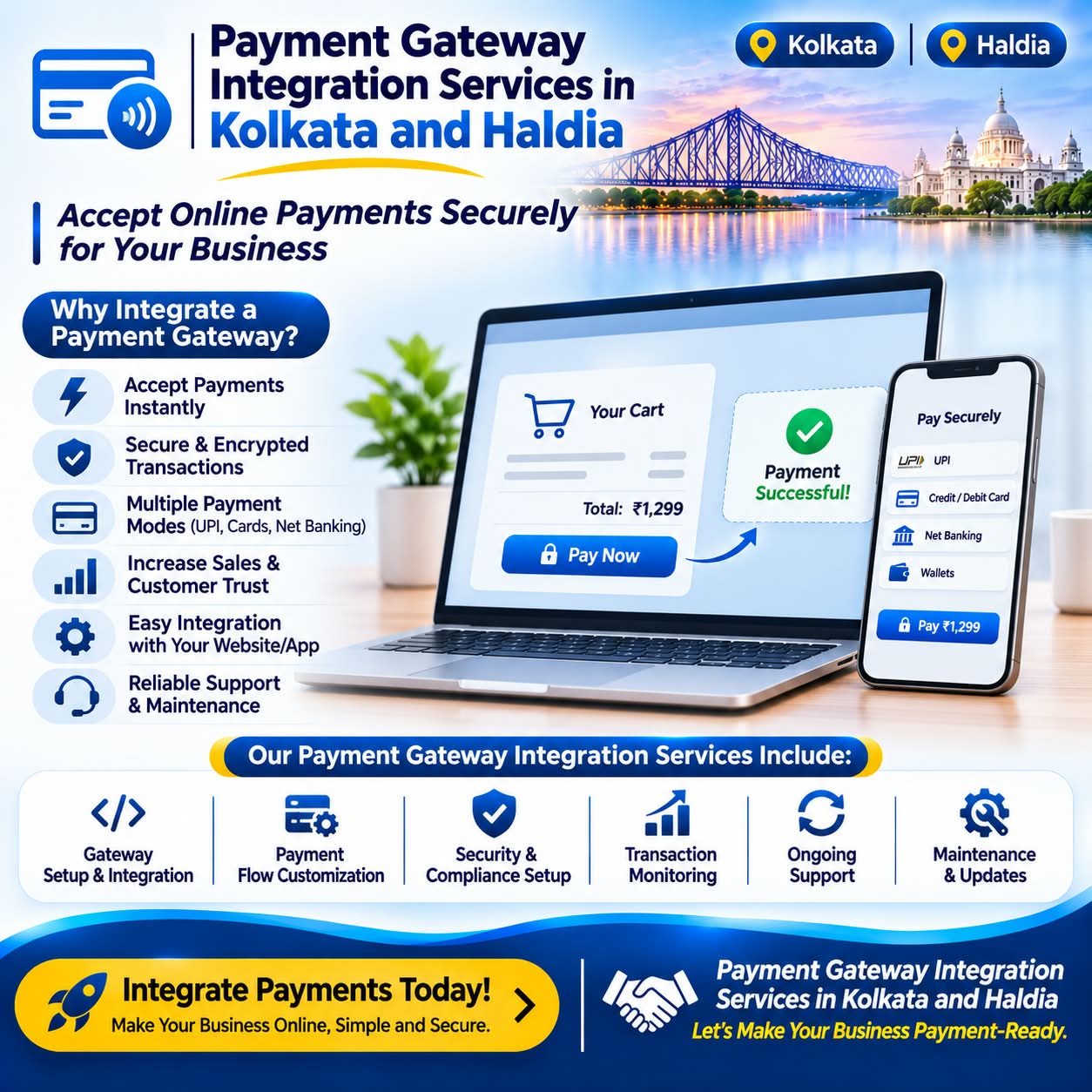
Payment Gateway Integration Services in Kolkata and Haldia: Accept Online Payments Securely
Need payment gateway integration in Kolkata or Haldia? Accept UPI, cards and online payments with secure website and mobile app integration by HSR.
S
System Admin
· 11 min read
In this article
Payment Gateway Integration Services in Kolkata and Haldia: Accept Online Payments Securely
Customers today expect convenient ways to pay for products and services online. Whether they are purchasing from an e-commerce store, booking an appointment, enrolling in an online course or paying for a service, a smooth payment experience can make the transaction easier.
For businesses in Kolkata and Haldia, accepting online payments can help simplify collections and support digital business operations.
However, adding a payment button to a website is not enough. A properly integrated payment system needs to handle transaction requests, payment verification, order updates, failed transactions and refunds.
This is where payment gateway integration becomes important.
In this guide, we explain how payment gateway integration works, which features businesses should consider and how to choose the right development partner.
What Is Payment Gateway Integration?
A payment gateway is a service that allows businesses to accept online payments through websites and mobile applications.
Payment gateway integration is the process of connecting a business's digital platform with a payment service provider so customers can complete transactions online.
Depending on the provider and merchant account, supported payment methods may include:
UPI
Debit cards
Credit cards
Net banking
Supported digital wallets
Other available payment methods
For example, when a customer purchases a product from an online store, the website can redirect the customer to a payment checkout or display an integrated payment interface.
After the transaction, the application receives the payment status and updates the relevant order or booking record.
Why Businesses in Kolkata and Haldia Need Online Payment Integration
Businesses are increasingly using websites and applications to sell products, accept bookings and collect service payments.
A suitable payment integration can support these activities in several ways.
1. Accept Payments Beyond Physical Locations
A business does not always need to depend on customers visiting its premises to collect payments.
With an integrated online payment system, customers can pay remotely through a supported website or application.
This can be useful for service providers, educational institutes, retailers and businesses selling products online.
2. Make Customer Checkout Easier
Customers should be able to understand the payment process without unnecessary steps.
A well-designed checkout can display the order amount, available payment methods and transaction status clearly.
A simpler payment experience can reduce avoidable confusion during checkout.
3. Reduce Manual Payment Confirmation
When online payment status is verified through a properly configured integration, the application can update relevant records automatically.
For example, a successful payment can trigger an order confirmation or mark a booking as paid.
Businesses should use verified server-side payment responses rather than relying only on information displayed in the customer's browser.
4. Maintain Digital Transaction Records
An integrated payment system can help businesses maintain transaction references, payment statuses, timestamps and related order information.
These records can support reconciliation and customer support.
5. Support Business Growth
As businesses expand their online operations, they may need payment collection across websites, mobile applications, subscription services and customer portals.
A well-planned integration can support these different use cases, subject to the selected payment provider's capabilities.
Popular Payment Gateway Options for Indian Businesses
Indian businesses have access to multiple payment gateway providers. The right choice depends on business type, payment methods, integration requirements, settlement arrangements and commercial terms.
Some commonly considered providers include:
1. Razorpay
<text>Razorpay</text> offers payment infrastructure for businesses that want to accept online payments through websites and applications.
Depending on account approval and product availability, businesses can explore payment links, checkout integration, recurring payment options and transaction management.
Important: Payment gateway availability, pricing, settlement timelines and supported features can change. Always verify current details directly with the provider before making a decision.
Essential Features of a Professional Payment Gateway Integration
A reliable payment integration involves more than initiating a transaction. It should manage the complete payment lifecycle.
1. Secure Checkout
The checkout interface should clearly display the order amount and available payment methods.
It should also work properly across desktop computers, tablets and mobile devices.
2. Server-Side Payment Verification
This is one of the most important parts of payment integration.
After a customer completes a transaction, the backend should verify the payment using the payment provider's supported verification mechanism.
The application should not mark an order as paid simply because the customer returns to a success page.
3. Webhook Integration
Payment providers can send server-to-server notifications, commonly known as webhooks, when important transaction events occur.
These notifications can help applications process events such as:
Payment successful
Payment failed
Refund initiated
Refund processed
Other supported transaction updates
Webhook signatures should be verified, and duplicate event handling should be implemented.
4. Payment Status Management
A payment system should maintain clear transaction states.
Examples include:
Pending
Successful
Failed
Cancelled
Refund initiated
Refunded
The exact status model depends on the payment provider and application workflow.
5. Refund Management
Businesses may need to refund customers due to cancellations, duplicate payments or other approved reasons.
A payment integration can support refund initiation and status tracking when these capabilities are provided by the gateway.
6. Transaction History
An administrative dashboard can display transaction references, order details, payment amounts, dates and statuses.
This helps authorised staff investigate payment-related customer queries.
7. Notifications and Receipts
After a successful transaction, the application can send a confirmation through supported email or messaging integrations.
The notification should include relevant transaction information without exposing sensitive payment credentials.
How Payment Gateway Integration Works
A typical payment gateway integration follows these steps.
Step 1: Customer Places an Order
The customer selects a product, service, course or booking and proceeds to checkout.
Step 2: Backend Creates a Payment Request
The application backend creates a payment order or transaction request using the provider's supported API.
Step 3: Customer Completes Payment
The customer is presented with the supported payment interface and selects an available payment method.
Step 4: Payment Provider Processes the Transaction
The payment provider processes the request and returns the transaction outcome through its supported mechanisms.
Step 5: Backend Verifies Payment
The application verifies the transaction using the required signature, API or webhook validation process.
Step 6: Application Updates the Order
Once the payment is verified, the system updates the order, booking or subscription status.
Step 7: Customer Receives Confirmation
The customer receives an appropriate confirmation, and the business can view the transaction in its administrative dashboard.
Payment Gateway Integration for Different Business Types
Different businesses need different payment workflows.
E-commerce Businesses
Online stores can use payment gateway integration to collect payments for customer orders.
The integration may connect payments with product orders, inventory updates, order confirmations and shipping workflows.
Educational Institutions and Coaching Centres
Institutions can accept online payments for course enrolments, application fees, training programmes and other approved charges.
The platform may also maintain student-wise payment records.
Hotels and Hospitality Businesses
Hotels and guest houses can use online payments for advance bookings, reservations and other services, depending on their booking process.
Service-Based Businesses
Consultants, agencies and professional service providers can accept payments for projects, service bookings or invoices.
Subscription-Based Platforms
Software businesses and online platforms may require recurring payments.
Subscription integration should be planned around the payment provider's supported recurring-payment products, customer authorisation requirements and applicable rules.
Payment Gateway Integration for Websites vs Mobile Applications
Businesses may need online payments on a website, mobile application or both.
Feature
Website Integration
Mobile App Integration
Customer access
Browser
Android or iOS application
Checkout
Web checkout
App-compatible checkout
Payment verification
Backend verification
Backend verification
Transaction records
Website database
Application backend
Notifications
Web or email notifications
Push, email or supported notifications
Integration method
Provider APIs and checkout tools
Provider SDKs or supported APIs
Both approaches require secure backend communication and reliable payment verification.
The implementation should follow the payment provider's official integration documentation.
Common Payment Integration Mistakes to Avoid
Poorly implemented payment systems can create customer complaints and reconciliation problems.
Avoid these common mistakes:
Trusting the frontend success page: A success redirect alone is not sufficient proof of payment.
Not verifying webhook signatures: Unverified webhook events can create security and transaction-integrity risks.
Ignoring duplicate requests: The system should handle repeated payment requests and webhook deliveries safely.
Not handling failed transactions: Customers should receive clear feedback when a payment does not complete.
Missing refund workflows: Businesses should understand how refunds are initiated and tracked.
Exposing secret credentials: API keys and secret credentials must not be placed in public frontend code or exposed through public repositories.
Skipping testing: Test successful payments, failures, cancellations, duplicate events and refunds before launching the integration.
How to Choose a Payment Gateway Integration Company in Kolkata or Haldia
Selecting the right development partner is important because payment functionality is directly connected to customer transactions.
Before choosing a company, consider these factors.
Technical experience: Check whether the development team has experience with website, mobile application and backend integrations.
Provider compatibility: Confirm that the team can work with the payment gateway you intend to use.
Security practices: Discuss server-side verification, webhook validation, credential protection and transaction handling.
Error handling: Ask how failed transactions, duplicate requests and delayed payment notifications will be managed.
Administrative reporting: Confirm whether the business will have access to transaction history and payment-status records.
Maintenance and support: Understand who will handle API changes, integration issues and future improvements.
A good payment integration project should be designed around the complete transaction lifecycle, not just the checkout screen.
Payment Gateway Integration Services by HSR Hi-Tech Solutions
HSR Hi-Tech Solutions provides website development, mobile application development and custom software services for businesses in Kolkata, Haldia and across India.
Our payment gateway integration services can help businesses connect online payment systems with their existing or newly developed digital platforms.
Depending on project requirements, the integration may include:
Payment gateway setup and configuration
Razorpay and other supported gateway integrations
UPI and online payment workflows
Website checkout integration
Mobile application payment integration
Server-side payment verification
Webhook implementation
Transaction status management
Refund workflow integration
Payment reporting and administrative dashboards
HSR also provides e-commerce development and custom application development for businesses that need payment functionality as part of a larger digital platform.
Payment gateway integration connects a website or mobile application with an online payment provider so customers can make digital payments for products and services.
2. Which payment gateway is best for businesses in Kolkata?
The best provider depends on your business type, payment methods, transaction volume, settlement requirements, integration features and commercial terms. Compare providers before selecting one.
3. Can I integrate UPI payments into my business website?
Yes. A supported payment gateway can allow businesses to accept UPI payments through their websites, subject to provider onboarding and account approval.
4. Can payment gateways be integrated into Android and iOS applications?
Yes. Payment providers offer supported mobile integration methods, such as SDKs or checkout flows, depending on the platform and product.
5. How much does payment gateway integration cost in Kolkata?
The development cost depends on the website or application, selected payment provider, backend requirements, transaction workflows, testing and administrative features. Payment gateway transaction charges are separate and are determined by the provider.
6. How long does payment gateway integration take?
A standard integration may take less time than a custom payment workflow involving subscriptions, multiple gateways, refunds, complex order management or additional reporting. The timeline should be confirmed after reviewing the requirements.
7. Is payment gateway integration secure?
It can be implemented securely by following the provider's official documentation, using HTTPS, protecting credentials, validating payment signatures and webhooks, and avoiding unnecessary storage of sensitive payment information.
8. Does HSR Hi-Tech Solutions provide payment gateway integration in Haldia?
HSR Hi-Tech Solutions provides website development and payment gateway integration services for businesses in Haldia, Kolkata and other locations, depending on project requirements.
Conclusion
Online payment integration has become an important part of modern business websites and applications. A properly implemented payment gateway can help businesses accept digital transactions, maintain payment records and create a more convenient customer checkout experience.
For businesses in Kolkata and Haldia, selecting the right payment provider and implementing a secure transaction workflow are important steps towards building reliable digital services.
HSR Hi-Tech Solutions helps organisations integrate payment functionality into websites, mobile applications and custom software platforms.
Need payment gateway integration for your website or mobile application?
Part of the team at HSR Hi-Tech Solutions, an MSME-registered IT company in Kolkata and Haldia building websites, apps, ERP and AI solutions, and running the marketing campaigns we write about.
Looking for website redesign services in Kolkata or Haldia? Upgrade your outdated website with modern design, mobile responsiveness and improved user experience.



.jpeg)