Discover tailored solutions for your business needs with our free quote service. Let our experts at HSR Hi-Tech Solutions guide you towards success. Request your complimentary quote today!
Thank you!
Your request has been submitted successfully.
Our team will reach out to you soon.
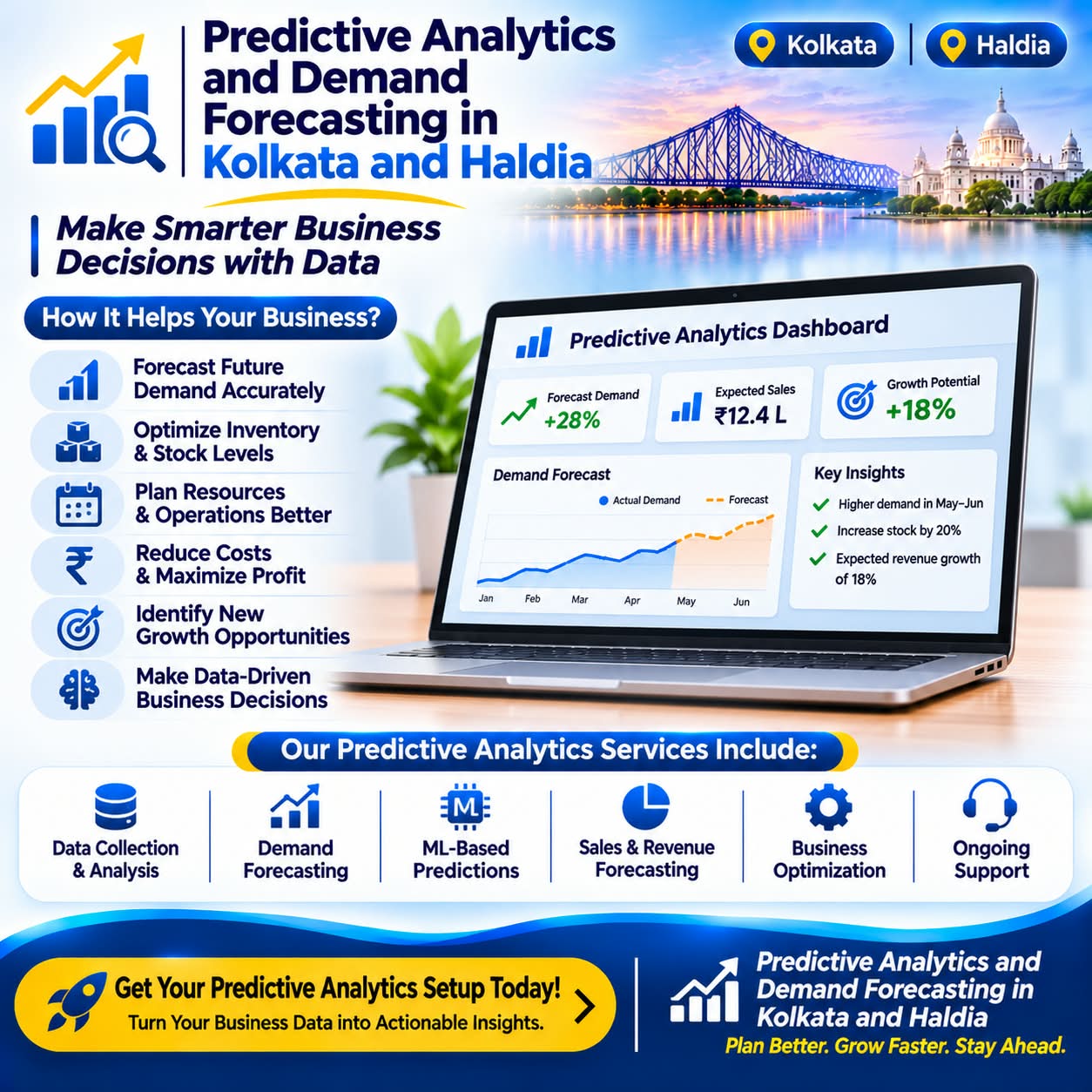
Predictive Analytics and Demand Forecasting in Kolkata and Haldia: Make Smarter Business Decisions with Data
Discover how predictive analytics and demand forecasting help businesses in Kolkata and Haldia estimate demand, plan inventory and make data-driven decisions.
S
System Admin
· 10 min read
In this article
Predictive Analytics and Demand Forecasting in Kolkata and Haldia: Make Smarter Business Decisions with Data
Businesses make important decisions every day. How much stock should be purchased? How many employees will be required next month? Which products are likely to sell more during the coming season? When should a company increase its marketing budget?
Traditionally, many of these decisions have depended on past experience, manual calculations and assumptions. While experience remains valuable, businesses can make more informed decisions by analysing historical information and identifying patterns in their data.
This is where predictive analytics and demand forecasting become useful.
For growing businesses in Kolkata and Haldia, predictive analytics can help estimate future trends, understand customer behaviour, plan inventory and prepare for changing market conditions. By combining data science, statistical methods and machine learning, organisations can use their existing business information to support better planning.
HSR Hi-Tech Solutions provides data science and AI/ML development services for businesses looking to turn their data into practical insights.
What Is Predictive Analytics?
Predictive analytics is the process of analysing historical and current data to estimate what may happen in the future.
It uses statistical techniques, data analysis and machine learning models to identify patterns and relationships within datasets.
For example, a retail business can analyse its previous sales records to estimate which products may experience higher demand during the next month. A hotel can examine seasonal booking patterns to support room availability planning. A manufacturing company can analyse production and order history to estimate future material requirements.
Predictive analytics does not guarantee that a particular event will happen. Instead, it provides data-based estimates that help decision-makers evaluate possible outcomes.
What Is Demand Forecasting?
Demand forecasting is the process of estimating the future demand for a product, service or resource.
Businesses use forecasting to plan purchasing, inventory, staffing, production, budgets and other operational activities.
A demand forecasting model may consider:
Historical sales and order records.
Seasonal demand patterns.
Product categories and pricing.
Customer purchasing behaviour.
Marketing campaigns and promotions.
Business growth trends.
External factors, where reliable data is available.
The quality of a forecast depends on the accuracy, relevance and completeness of the information used to build it.
Why Businesses in Kolkata and Haldia Should Consider Predictive Analytics
Businesses across Kolkata and Haldia operate in different sectors, including retail, manufacturing, logistics, education, hospitality and professional services.
Each sector generates information that can help improve planning. However, this information is often spread across spreadsheets, billing systems, accounting software and separate business applications.
Predictive analytics can help organisations use this information more effectively.
1. Improve Inventory Planning
Maintaining too much inventory can increase storage and operational costs. Keeping too little stock can result in missed sales and delayed deliveries.
By analysing historical sales, stock movement and seasonal patterns, businesses can estimate future product demand and make more informed purchasing decisions.
2. Estimate Future Sales
Sales forecasting helps business owners understand possible revenue trends and prepare realistic operational plans.
A forecasting model can analyse previous sales, monthly performance, customer activity and other relevant variables to estimate future sales.
These estimates can support budgeting, target setting and business planning.
3. Plan Workforce Requirements
Businesses with changing workloads may need different staffing levels at different times.
Historical workload, attendance, booking or transaction records can help estimate future resource requirements. Managers can use these insights while planning shifts, staffing and operational capacity.
4. Identify Changing Business Trends
Predictive analytics can help identify patterns that may not be immediately visible in manually prepared reports.
For example, a business may discover that demand for certain products increases during specific months or that particular customer segments show different purchasing patterns.
These insights can help management investigate opportunities and prepare suitable strategies.
5. Support Better Budget Planning
Forecasting can provide estimates for future sales, expenses, resource requirements and operational activity.
Although predictions should not replace financial review, they can provide an additional reference when preparing budgets and evaluating different business scenarios.
Practical Applications of Predictive Analytics Across Industries
Predictive analytics can be applied to different business processes depending on the available data and the organisation's objectives.
Retail and E-commerce Businesses
Retailers can analyse transaction history, product performance and seasonal demand to estimate which products may sell more in the future.
Possible applications include:
Product demand forecasting.
Inventory replenishment planning.
Sales trend analysis.
Customer purchasing pattern analysis.
Product category performance estimation.
Manufacturing Companies
Manufacturing businesses can use historical production and order information to support operational planning.
Possible applications include:
Production demand forecasting.
Raw material requirement estimation.
Production trend analysis.
Equipment performance monitoring.
Identification of unusual operational patterns.
For industrial businesses around Haldia, these applications may be useful when planning production schedules and reviewing changing order requirements.
Hotels and Hospitality Businesses
Hotels and hospitality providers can analyse historical bookings, occupancy and seasonal trends.
Possible applications include:
Booking demand estimation.
Occupancy trend forecasting.
Seasonal resource planning.
Reservation pattern analysis.
Staff requirement planning.
Logistics and Transportation Businesses
Transportation and logistics companies can use historical shipment and delivery records to understand operational patterns.
Possible applications include:
Shipment volume forecasting.
Delivery demand analysis.
Fleet utilisation trends.
Route performance analysis.
Resource requirement estimation.
Educational Institutions
Educational organisations can analyse historical admissions, enrolment and attendance records to support institutional planning.
Possible applications include:
Admission trend analysis.
Course demand estimation.
Student enrolment forecasting.
Resource planning.
Historical performance analysis.
How Does an AI-Based Forecasting System Work?
A predictive analytics project generally involves several stages. The exact approach depends on the business problem, data availability and the accuracy requirements.
Step 1: Define the Business Objective
The first step is identifying what the organisation wants to estimate.
For example:
Monthly product demand.
Future sales volume.
Seasonal booking trends.
Raw material requirements.
Customer churn risk.
A clearly defined objective helps determine which information and modelling approach will be useful.
Step 2: Collect Historical Data
The required information may come from billing software, ERP systems, CRM platforms, spreadsheets, databases, website analytics or other business applications.
Data sources should be reviewed to understand whether the information is relevant and available at the required level of detail.
Step 3: Clean and Prepare the Data
Business datasets may contain duplicate entries, missing values, inconsistent dates and incorrect records.
Before building a forecasting model, data needs to be cleaned, standardised and validated.
Python libraries such as pandas and NumPy can help organise and prepare structured datasets for analysis.
Step 4: Analyse Historical Patterns
The next stage involves examining trends, seasonal variations, unusual changes and relationships between different variables.
This analysis helps determine whether the available information contains useful patterns for forecasting.
Step 5: Build and Evaluate the Model
Depending on the problem, the project may use statistical forecasting methods or machine learning algorithms.
The model should be tested against historical data that was not used for training. Its predictions should also be compared with a simple baseline to determine whether the model provides meaningful improvement.
Step 6: Present Forecasts and Insights
Predictions can be presented through reports, dashboards, charts or integrated software features.
A useful forecasting solution should explain what is being predicted, the period covered and the limitations of the estimate.
Step 7: Monitor and Improve
Business conditions change over time. A model that performs well today may become less accurate when customer behaviour, prices or market conditions change.
Regular monitoring and evaluation help identify when a model needs updating or retraining.
Predictive Analytics vs Traditional Business Reporting
Traditional reporting and predictive analytics serve different purposes. Both can be valuable when used together.
Traditional Reporting
Predictive Analytics
Explains historical performance
Estimates possible future outcomes
Focuses on what has happened
Focuses on what may happen
Uses summaries and historical metrics
Uses statistical and machine learning methods
Helps review past performance
Supports planning and decision-making
Often uses fixed reports
Can use models that are updated as new data becomes available
For example, a monthly sales report may show that a business sold 1,000 units last month. A forecasting model may use previous sales patterns and other relevant information to estimate demand for the next month.
The forecast is an estimate, not a guaranteed sales figure.
What Data Does a Business Need to Start?
A business does not necessarily need a large or complex data warehouse to explore predictive analytics.
The required data depends on the question being investigated.
For a basic sales forecasting project, useful information may include:
Transaction date.
Product or service identifier.
Quantity sold.
Selling price.
Order status.
Product category.
Historical sales totals.
For more advanced forecasting, additional variables may be useful, such as promotional activity, stock availability, holidays or external market information.
A data assessment should happen before development begins. If the information is insufficient or unreliable, improving data collection may be the most practical first step.
How HSR Hi-Tech Solutions Helps Businesses with Predictive Analytics
HSR Hi-Tech Solutions provides data science and AI/ML development services for organisations in Kolkata, Haldia and other locations.
Our approach starts with understanding the business problem rather than selecting an algorithm first.
Depending on the project requirements, our work can include:
Business data assessment.
Data cleaning and preparation.
Historical trend analysis.
Predictive model development.
Sales and demand forecasting.
Model evaluation and baseline comparison.
Dashboard and reporting integration.
API-based model deployment.
Model monitoring and improvement planning.
We work with technologies such as Python, pandas, NumPy and suitable machine learning frameworks based on the project requirements.
Our AI/ML development process focuses on measurable objectives, model evaluation and practical deployment. If the available data cannot support a reliable prediction, that limitation should be identified before a business invests in a larger implementation.
1. What is the difference between predictive analytics and demand forecasting?
Predictive analytics is a broader field that uses data to estimate future outcomes. Demand forecasting is a specific application that estimates future demand for products, services or resources.
2. Can small businesses use predictive analytics?
Yes. Small businesses can begin with focused projects such as sales trend analysis or product demand estimation. The approach should match the available data, budget and business objective.
3. How much historical data is required for demand forecasting?
There is no universal minimum. The amount of data depends on the forecasting problem, frequency of records, seasonal patterns and data quality. A data assessment is needed to determine whether a useful model can be developed.
4. Can predictive analytics be integrated with existing ERP or billing software?
Yes, depending on the software's technical capabilities. Forecasting outputs can be connected through APIs, scheduled data pipelines or other suitable integration methods.
5. Does predictive analytics guarantee accurate future predictions?
No. Predictions are estimates based on available information and modelling assumptions. Unexpected market changes, incomplete data and changing customer behaviour can affect accuracy. Models should be evaluated and monitored regularly.
6. How much does predictive analytics development cost in Kolkata?
The cost depends on the business problem, data preparation requirements, model complexity, integrations and deployment needs. HSR Hi-Tech Solutions offers AI/ML development engagements with proof-of-concept pricing starting from ₹49,999, subject to project scope.
7. Does HSR Hi-Tech Solutions provide predictive analytics services in Haldia?
HSR Hi-Tech Solutions has an office in Haldia and provides data science and AI/ML development services for businesses in Haldia, Kolkata and other locations.
Conclusion
Predictive analytics and demand forecasting can help businesses move beyond reviewing historical reports and start using their data for forward-looking planning.
From estimating product demand and sales trends to planning inventory, staffing and production, data-driven forecasting can support more informed business decisions.
However, useful predictions depend on reliable data, a clearly defined business objective and proper model evaluation. Businesses should begin with a focused use case, measure the results and expand only when the approach demonstrates practical value.
If your organisation is exploring predictive analytics, sales forecasting or AI-based business solutions, HSR Hi-Tech Solutions can help assess your requirements and identify a suitable development approach.
Part of the team at HSR Hi-Tech Solutions, an MSME-registered IT company in Kolkata and Haldia building websites, apps, ERP and AI solutions, and running the marketing campaigns we write about.
Looking for website redesign services in Kolkata or Haldia? Upgrade your outdated website with modern design, mobile responsiveness and improved user experience.