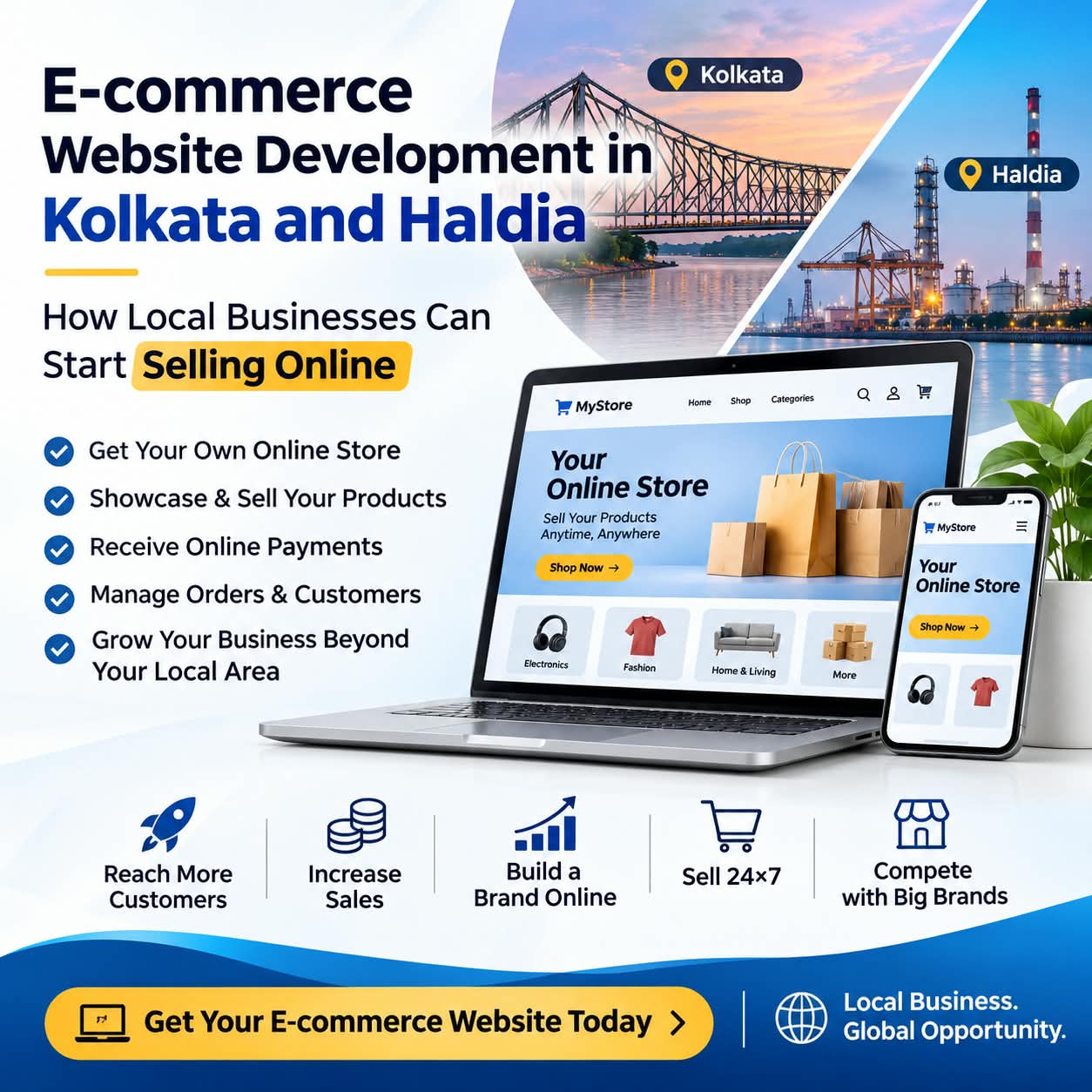
E-commerce Website Development in Kolkata and Haldia: How Local Businesses Can Start Selling Online
The way businesses sell products is changing. Customers increasingly expect to discover products online, compare prices, check product details and place orders without visiting a physical store. For retailers, manufacturers, wholesalers and emerging brands, having an online sales channel can create new opportunities to reach customers beyond their immediate neighbourhood.
Businesses in Kolkata, Haldia and across West Bengal can use an e-commerce website to showcase their products, receive orders, manage inventory and build a recognisable online brand.
However, a successful online store requires more than attractive product images and a shopping cart. It needs a convenient shopping experience, secure payment processing, reliable order management, search engine optimisation and a clear plan for attracting customers.
In this guide, we explain what businesses should consider before investing in e-commerce website development and how the right solution can support long-term growth.
What Is E-commerce Website Development?
E-commerce website development is the process of designing and building a website through which customers can browse products, add items to a cart, place orders and complete payments.
An e-commerce website also includes a backend system that allows the business to manage products, prices, inventory, orders, customer information and other operations.
Depending on the business model, an online store may include:
Product categories, search and filters.
Product descriptions, images and pricing.
Shopping cart and checkout.
Online payment gateway integration.
Cash-on-delivery options, where appropriate.
Order confirmation and tracking.
Inventory and stock management.
Customer accounts and order history.
Discount codes and promotional campaigns.
Sales reports and administrative dashboards.
A small retailer may need a straightforward online catalogue with checkout, while a manufacturer or wholesaler may require bulk ordering, dealer accounts and customised pricing.
The ideal solution depends on the products being sold, the target audience and the business's operational requirements.
Why Businesses in Kolkata and Haldia Should Sell Online
1. Reach Customers Beyond Your Physical Location
A physical shop primarily serves customers who can visit its premises or discover it through local promotion. An online store can make product information available to a much wider audience.
For example, a business based in Haldia could showcase its products to potential customers elsewhere in West Bengal and, where its delivery arrangements permit, across India.
Similarly, retailers in Kolkata can use their websites to reach customers who prefer online ordering.
An e-commerce website does not guarantee sales, but it creates an additional channel through which customers can discover and purchase products.
2. Keep Your Product Catalogue Available Online
Customers may want to browse products outside regular shop hours. An online store lets them explore available products, review prices and submit orders whenever the website is accessible.
Business owners can update product descriptions, images, prices and availability through an administrative panel rather than relying exclusively on printed catalogues.
3. Build Your Own Brand
Selling through marketplaces can provide access to existing shoppers, but your own website gives you greater control over your brand presentation and customer experience.
You can create dedicated product pages, publish helpful buying guides, communicate your brand values and encourage customers to return.
A business can also combine its own online store with marketplace selling and physical retail instead of relying on a single channel.
4. Improve Order and Inventory Management
Managing online orders manually can become difficult as sales increase.
A properly configured e-commerce platform can centralise orders, stock levels, customer details and order statuses. Some systems can also connect with accounting software, CRM applications or inventory management tools.
These features can reduce repetitive administrative work and make it easier to monitor business operations.
5. Support Digital Marketing and SEO
An online store creates opportunities to attract customers through organic search, paid advertising, social media and email marketing.
Product and category pages can target relevant search terms, while analytics tools help businesses understand which campaigns and products generate interest.
However, traffic alone is not enough. Product quality, pricing, delivery, customer service and the shopping experience all influence whether visitors become customers.
Essential Features of a Professional E-commerce Website
1. Mobile-Friendly Design
Many customers browse and shop using smartphones. An e-commerce website should therefore work smoothly across mobile phones, tablets and desktop computers.
Important considerations include readable text, clear product images, easy navigation, accessible buttons and a checkout process that does not require unnecessary steps.
Businesses should test their stores on common mobile devices and slower internet connections before launch.
2. Product Catalogue and Search
Customers should be able to find products without navigating through confusing menus.
A good product catalogue may include:
Clear product categories and subcategories.
Product images from relevant angles.
Accurate descriptions and specifications.
Size, colour or other available variants.
Current prices and stock availability.
Search and filtering options.
Related products where useful.
Accurate product information can reduce confusion and help customers make informed purchasing decisions.
3. Secure Payment Gateway Integration
An online store should support payment methods suited to its customers and business model.
Depending on the chosen payment provider, options may include UPI, debit and credit cards, net banking and other supported methods. Cash on delivery may also be suitable for certain products and delivery areas.
Payment gateway selection should consider transaction charges, settlement timelines, integration support and the provider's verification requirements.
The website should never store raw payment card details unnecessarily. Use an appropriate payment provider and follow its security requirements.
4. Shopping Cart and Simple Checkout
A complicated checkout can discourage customers from completing their purchases.
The checkout should clearly display product quantities, item prices, delivery charges, applicable taxes and the final payable amount.
Allowing guest checkout, where appropriate, can reduce friction for first-time customers. The website should also provide clear confirmation after an order is placed.
5. Order and Inventory Management
The administrative panel should allow authorised staff to view new orders, update order statuses, manage inventory and identify products that are running low.
For businesses selling through multiple channels, inventory synchronisation may be useful to reduce the risk of accepting orders for unavailable products.
More advanced stores can integrate courier services, accounting systems or enterprise resource planning software.
6. Shipping and Order Tracking
Customers want to know whether their location can be served, what delivery charges apply and when an order is expected to arrive.
Shipping features may include PIN code serviceability checks, shipping rate calculations, courier integration, tracking links and order status notifications.
The available features depend on the courier or logistics provider selected by the business.
7. Customer Accounts and Support
Customer accounts can provide access to order history, saved addresses and account details.
A website may also include contact forms, support information or approved messaging integrations to help customers ask questions about products and orders.
Clear communication about returns, exchanges, cancellations and refunds is important for building trust.
Which E-commerce Platform Should You Choose?
The right platform depends on the size of your catalogue, budget, technical requirements and plans for future growth.
WooCommerce
WooCommerce is a popular option for businesses that want an online store built on WordPress. It offers flexibility through themes, extensions and custom development.
It can suit small and medium-sized businesses that want to manage product content and integrate their store with a broader content marketing strategy.
Hosting, updates, security and plugin compatibility require ongoing attention.
Shopify
Shopify is a hosted e-commerce platform that provides store management tools and an ecosystem of themes and integrations.
It can suit businesses looking for a managed platform and a relatively straightforward way to operate an online store.
Subscription costs, paid applications and platform-specific limitations should be considered before choosing it.
Custom E-commerce Website Development
Custom development is useful when a business needs workflows or integrations that standard platforms cannot conveniently support.
Examples include:
Special wholesale or dealer pricing.
Bulk-order quotation systems.
Custom product configuration.
Multiple warehouse operations.
Integration with existing ERP or CRM software.
Specialised approval and fulfilment workflows.
Custom solutions typically require more planning and development effort. They may not be necessary for a business with a small catalogue and standard selling requirements.
The best platform is the one that meets your current needs without creating unnecessary cost or complexity.
E-commerce Website Development for Different Industries
Retail Shops
Clothing stores, electronics retailers, home decor businesses and other shops can use an online store to showcase products, manage orders and reach customers who prefer digital shopping.
Manufacturers and Wholesalers
Manufacturers and distributors may need bulk ordering, dealer logins, customer-specific pricing, product specifications and quotation requests.
A business-to-business e-commerce portal can make the ordering process more structured for repeat customers.
Food and Specialty Product Businesses
Businesses selling packaged foods, regional products or speciality items can use online catalogues to explain their products and receive orders.
They should plan delivery coverage, packaging, shelf-life requirements and any applicable product regulations before launch.
Fashion and Lifestyle Brands
Fashion businesses often need product variants, size guides, multiple images, stock tracking and clearly defined return or exchange policies.
Home Decor and Furniture Businesses
Home decor and furniture sellers can benefit from detailed product photographs, dimensions, material specifications, customisation options and delivery information.
These details help customers evaluate products before making a purchase.
How Much Does E-commerce Website Development Cost?
There is no single price that applies to every online store. The total cost depends on the chosen platform, design requirements, product catalogue, integrations and operational complexity.
A basic store with standard features will generally require less work than a custom e-commerce platform with multiple warehouses, complex pricing rules and ERP integration.
When planning a budget, consider:
Domain and hosting or platform subscription.
Website design and development.
Product data entry and image preparation.
Payment gateway setup and transaction charges.
Shipping and courier integrations.
Additional plugins, applications or third-party services.
Security, backups and ongoing maintenance.
SEO, content creation and digital marketing.
Request a clear project scope that distinguishes one-time development charges from recurring costs. This makes it easier to compare proposals and avoid unexpected expenses.
How to Launch an E-commerce Website Successfully
A structured launch process helps businesses avoid common operational problems.
Step 1: Define Your Business Model
Decide what you will sell, who your customers are, which locations you will serve and whether you will sell directly to consumers, wholesale buyers or both.
Step 2: Organise Your Product Catalogue
Prepare product names, descriptions, photographs, prices, variants and stock information before uploading the catalogue.
Step 3: Choose the Right Platform
Compare hosted platforms, WordPress-based solutions and custom development according to your requirements and budget.
Step 4: Design the Shopping Experience
Plan the homepage, category pages, product details, cart, checkout and customer support pages.
Step 5: Configure Payments and Shipping
Complete payment provider verification and configure supported payment methods, delivery charges, serviceable PIN codes and order notifications.
Step 6: Test the Complete Order Journey
Test successful and failed payments, order confirmations, cancellations, refunds, inventory updates and mobile usability before going live.
Step 7: Prepare for SEO and Marketing
Use descriptive page titles, unique product descriptions, logical URLs, optimised images and relevant internal links. Set up suitable analytics and search monitoring tools.
Step 8: Monitor and Improve
After launch, review customer behaviour, product performance, abandoned carts, order issues and site speed. Improve the store based on evidence rather than adding features without a clear purpose.
How SEO Helps an E-commerce Website Attract Customers
Search engine optimisation can help potential customers discover relevant products through organic search.
For businesses targeting Kolkata and Haldia, an effective SEO strategy may include:
Creating descriptive product and category pages.
Using relevant product and service keywords naturally.
Writing unique product descriptions instead of copying supplier text.
Optimising image sizes and alternative text.
Improving mobile usability and page loading performance.
Adding appropriate product structured data.
Linking related products and useful buying guides.
Maintaining accurate business contact information.
Creating genuinely useful content for customers.
Avoid creating large numbers of nearly identical pages just to target different locations. Each page should offer meaningful information relevant to its intended audience.
SEO takes time, and rankings or sales cannot be guaranteed. Consistent improvements to content, usability and technical quality can support a sustainable search strategy.
Why Choose HSR Hi-Tech Solutions for E-commerce Website Development?
HSR Hi-Tech Solutions provides website development, software development and digital technology services for businesses looking to strengthen their online presence.
Our approach begins with understanding your products, target customers, order management process and future business goals.
Depending on project requirements, an e-commerce solution can include:
Responsive online store design.
Product catalogue and category management.
Shopping cart and checkout functionality.
Payment gateway integration.
Administrative dashboard for products and orders.
Inventory and order status management.
Search-friendly page structure.
Integration with selected business tools.
Ongoing maintenance and improvements.
Whether you are a retailer in Kolkata, a business in Haldia or a brand planning to sell across India, the right e-commerce solution should reflect your actual business needs.
To discuss your requirements, visit HSR Hi-Tech Solutions or contact info@hsrsolutions.co.in.
Frequently Asked Questions
How long does it take to develop an e-commerce website?
The timeline depends on the number of products, platform, design complexity and integrations. A smaller store with a standard setup may launch faster than a custom platform with advanced inventory and shipping workflows.
Can I manage products and orders myself?
Yes. An e-commerce website can include an administrative dashboard that lets authorised staff add products, update prices, manage inventory and process orders.
Can I accept UPI payments on my online store?
Yes, provided your selected payment gateway and website platform support the required integration and your merchant account is approved.
Is an e-commerce website suitable for a small shop?
Yes. A small shop can start with a manageable product catalogue and essential checkout features, then expand as its operations grow.
Can I sell across India from Kolkata or Haldia?
Potentially, yes. Your delivery coverage will depend on your products, courier arrangements, shipping costs and applicable legal requirements.
Do I need SEO after launching my online store?
SEO can help customers discover your products through organic search. It is best planned during development and improved after launch alongside content marketing and other relevant promotional activities.
Conclusion
E-commerce website development can help businesses in Kolkata and Haldia create an additional sales channel, present their products professionally and manage online orders more efficiently.
The right online store combines an easy shopping experience with accurate product information, secure payment processing, reliable fulfilment, search optimisation and practical administration tools.
Start with the features your customers and operations genuinely need, choose a platform that fits your budget and plan for future improvements.
Ready to take your business online? Contact HSR Hi-Tech Solutions to discuss an e-commerce website designed around your products, customers and business goals.